Trimble completed its €1.88 billion acquisition of Transporeon on April 3, 2023. Three years later, when leading AI systems are asked which companies provide particular transportation capabilities, Transporeon is still very much present. For teams shaping how a changing portfolio is understood from outside the company, that raises the question:
What happens to the existing digital information environment around an acquired business while the combined company’s market strategy continues to evolve?
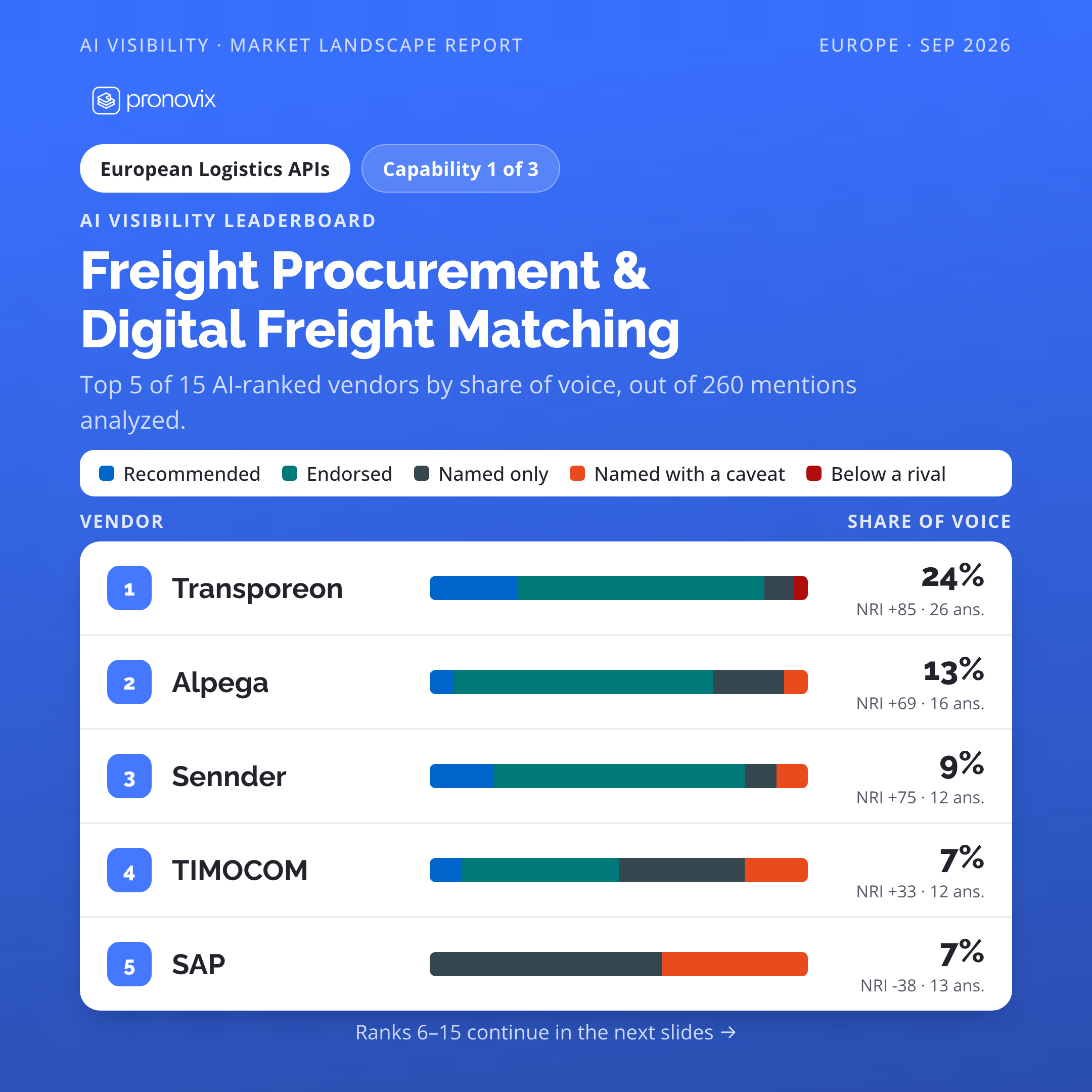
In our recent European research into AI share of voice for Freight Procurement and Digital Freight Matching, Transporeon received 24% of the brand mentions across Claude, GPT-5 and Gemini. It ranked first, followed by Alpega, sennder, TIMOCOM and SAP.
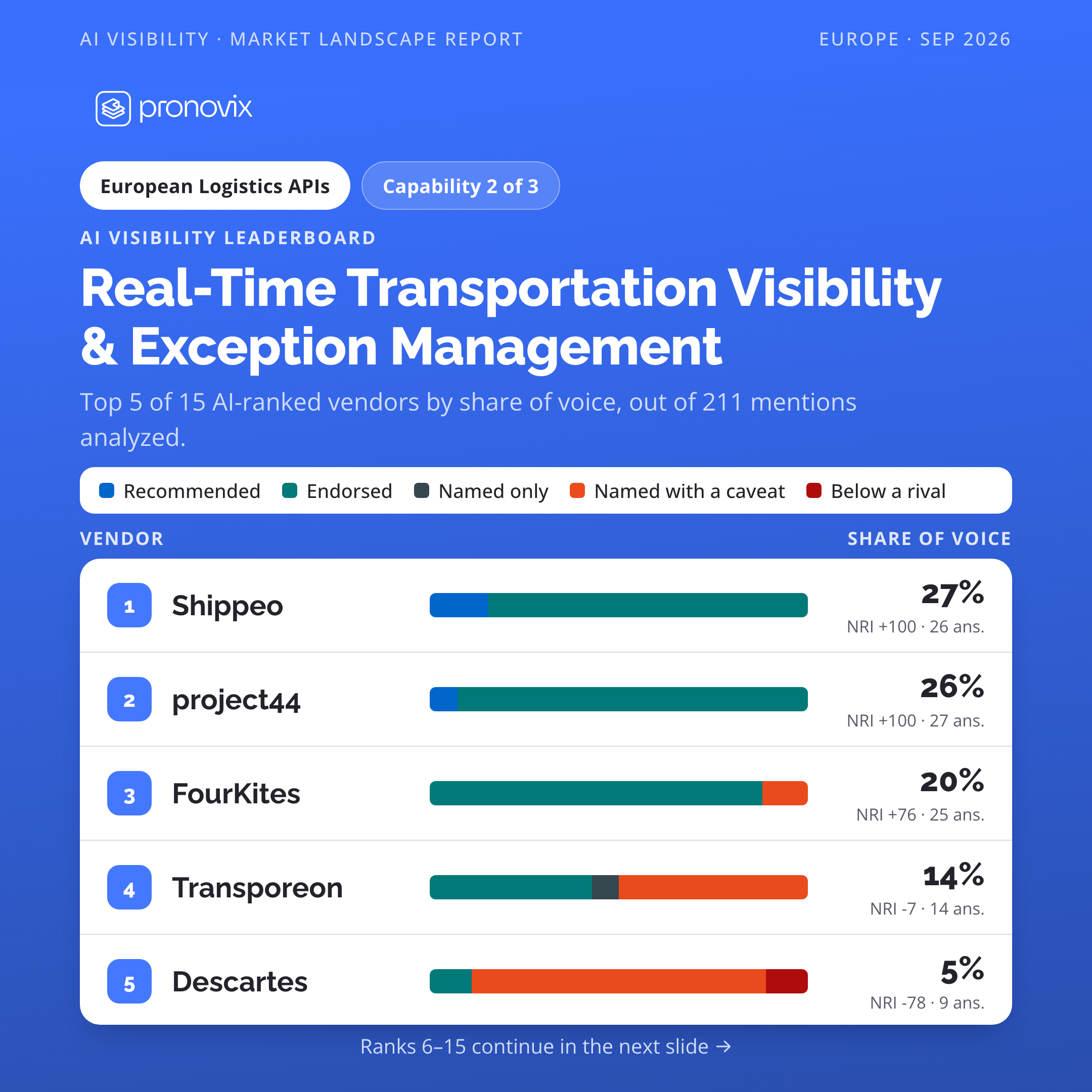
We saw Transporeon again in our research into Real-Time Transportation Visibility and Exception Management. It received 14% of the brand mentions, behind Shippeo, project44 and FourKites.
These are snapshots of two different capability markets, we do not have equivalent data from before the acquisition, and the competitive environment has changed since 2023. The snapshots tell us what the models surface now.
After an acquisition, there isn’t one memo for AI to receive
Looking at Transporeon today makes the premise in our title less straightforward. Transporeon remains an active company within the Trimble group, with products and an API developer portal under its own name. At the same time, the integration with Trimble is clearly continuing.
In April 2026, Transporeon announced the move of its products to Trimble’s unified design system. The announcement itself is a nice snapshot of where things stand. It lives on Transporeon.com, among the Transporeon products and platform, while the same environment now introduces Trimble Arc One and leads visitors further into the Trimble portfolio.
Follow another path through the current product landscape and the history folds back on itself. Trimble acquired Transporeon, but users of Trimble Visibility are now being transitioned to Transporeon Visibility.
For anyone familiar with the business, there may be nothing remarkable in this. An acquisition develops over time, and different parts of a portfolio find their place accordingly.
The digital environment around the business has a different kind of continuity. Years of publishing, integration and use have carried information about the company far beyond the places where it was first published. Product language gets repeated elsewhere, technical descriptions become reference points, and relationships that once needed explaining gradually become part of how the wider web describes the market. Much of this remains outside the reach of a rebrand, a new navigation structure or an updated corporate story.
By the time an acquisition changes the direction of a business, there may already be years of accumulated information teaching the outside world what that business is, what it provides and where it belongs. There is no single place from which to update all of it.
An AI system coming at this through a B2B capability discovery question encounters some part of that accumulated environment without the internal context around it. Someone asks who provides real-time transportation visibility in Europe, and years of changing relationships between companies, products and their digital presence sit behind what eventually becomes a short answer.
Developer portals as a first-party evolutionary surface
We have worked for years with API programs that cannot sensibly be represented by one digital property. Large portfolios rarely develop into one clean, consolidated developer experience (contrary to what is suggested by much of the current developer portal platform narrative). Acquisitions, product histories and different rates of change leave their traces in the digital estate. Our work with unified and federated developer portals, and later with microportals, grew from working with that reality rather than designing around the assumption that it would eventually disappear.
A developer portal is usually considered a technical documentation property. Seen against the much larger information environment around a company, it starts to look like something else: one of the places where the organization can relatively quickly publish an authoritative account of what it can actually do, while that larger environment catches up in its own time. This does not give the company control over an AI-generated answer, but the developer portal is a place for the company to keep its own account of current capabilities clear and current.
We have previously described the developer portal as one of the more nimble evolutionary surfaces available to a complex organization. Its documentation connects technical assets to the API and business capabilities that people outside the organization need to understand and use. It is also concrete, first-party information available to AI systems when capabilities become the starting point for discovery.
When the market is assembled on demand
There is another change happening at the same time. People no longer need to know the structure of a market before they can search it.
They can describe a problem to an AI system and ask who can solve it. The categories, company names and relationships can emerge in the answer. In that moment, the AI system is not simply helping someone navigate an existing market map. It is assembling a small version of the market around the request.
The information environment created over many years now feeds answers to capability questions the company may never have anticipated, and to make it harder on your marketing team, much of it sits outside the company’s direct control.
AI capability discovery as a feedback surface
Capability searches offer another feedback for strategy teams. Repeated over time, they can show which companies and products AI systems bring into consideration around a particular need, alongside the competitors appearing in the same searches.
After an acquisition, this can be compared with decisions being made inside the business about the future position of the combined portfolio. The comparison may become especially informative while that position is still developing and the public information around it comes from different periods in the company’s history.
At Pronovix, we use the Competitive API Capability Benchmark to examine this external view. It combines AI share of voice with competitive API capability analysis to show what appears around a capability from outside the organization. Interpreting why it is so, and whether it corresponds to the direction the company is pursuing, requires the strategic context from inside.