Banking Developer Portals UX Assessment: Discovery and Evaluation in a Hybrid Workflow

Best Practices, Examples, Antipatterns

Authors

Kathleen De Roo, Information Architect & UX Researcher, Head of Service teams
Laura Vass, Co-founder, Editor, Research & Knowledgesharing
Mónika Mikházi, UX Researcher


This UX assessment evaluates the maturity of developer portals within the traditional banking sector, focusing on the critical pre-login discovery and evaluation stages of the user journey. The report examines how effectively 19 major financial institutions present their solutions to the hybrid user, demonstrating that human cognitive friction directly blocks AI visibility. 

By highlighting best practices like outside-in content design and commercial transparency, we outline how banks can better align technical capabilities with business value

Furthermore, the report warns against costly anti-patterns like login depression and structural asymmetry, proving that a frictionless, integrated experience is essential for both human decision-makers and AI-mediated workflow.

We intentionally designed the report as a long-form qualitative assessment meant to support deeper understanding. Its core value lies in the expert interpretation of recurring patterns, structural trade-offs, and nuanced recommendations developed throughout the evaluation. As such, the report is both descriptive and prescriptive: it documents recurring realities observed across the assessed portals while also outlining practical recommendations and strategic considerations for organizations reassessing their developer portal maturity.

Report scope and perspective

This report evaluates developer portal maturity from the perspective that improving API portal content for commercial integration fit, evaluation success, and ecosystem adoption is strategically beneficial to the provider. 

We recognize however, that many banking APIs were exposed because regulation mandated ecosystem access. Meanwhile the economic upside often accrued more directly to third-party innovators than to the incumbent institutions themselves. As a result, some decisions that appear as discoverability, UX, or AI-visibility antipatterns may be due to prior, deliberate business-, compliance-, or competitive considerations.

To highlight the recurring best practices and anti-patterns that impact the crucial early stages of discovery and decision-making, Pronovix audited 19 best-in-class developer portals from corporations in the banking and financial services sector from January through May 2026. Rather than exhaustively reviewing every available product, we used representative sampling to evaluate these portals from the perspective of both human evaluators and AI-mediated workflows.

Our assessment intentionally focused on the public-facing developer portal experience rather than authenticated environments or guided onboarding processes. This approach allowed us to evaluate the portals from the perspective of both first-time and AI-assisted users, helping reveal friction points, discoverability gaps, structural fragmentation, and machine-readability issues that affect early-stage discovery and evaluation.


Why did we focus our assessment strictly on the pre-auth journey? 
Read our deep-dive into hybrid workflows and solution discovery.

Discovery and orientation support: array or disarray?

Is the discovery process leading to a dead-end?

Discovery is the time when your users are exploring: they have a hint or expectation that what they are looking for might be offered by Company, but they are not yet committed to a specific solution. 

Unfortunately, the discovery process frequently leads to a dead-end on many of the the observed developer portals. Dead-end discovery occurs for example when one successfully finds a specific solution or an API overview page that highlights product benefits, but then the portal fails to provide a clear evaluation path forward, or only after some immediate action such as registration or direct contact. Users are left stranded or fully blocked, and they have to decide to put in the renewed activation energy to continue.

Best practices

Successful support of solution and capability discovery requires complex thinking and deep understanding of user behaviour and expectations. 

  • Capture user intent. Remember the number 1 rule of UX: You are not your user.
  • Provide next steps redundantly, not only from the landing page. Pathways to success.
  • Provide contextual navigation and emphatically support towards the next steps.
  • Use descriptive labels that align with the user’s mental model, for example based on specific industry segment or use case 

Examples 

The homepage is usually the first point of contact. Users that feel they are in the right place will start exploring what it is you offer. As a company, you can support that exploration through redundant call-to-actions that capture attention, but you can go further and offer interactive tools for example a quiz or site configuration options in our research sample.

Screenshot of the menu items on the Nordea API Market for the 2026 Pronovix Developer Portal UX Maturity Report

Nordea developer portal (screenshot May 2026) – homepage with many call-to-actions


Screenshot from Citi Developer Portal for the 2026 Pronovix Developer Portal UX Maturity Report

Citi developer portal (screenshot May 2026) - option discovery quiz


Screenshot from the Standard Chartered Developer Portal for the 2026 Pronovix Developer Portal UX Maturity Report

Standard Chartered developer portal (screenshot May 2026) – complete site customization through industry segment and location filtering


Antipatterns to avoid

  • Lack of next steps for further autonomous exploration. Only available options are to subscribe for more information or contact sales, or having only generic contact forms
  • Design glitches such as unintended 404s, unclickable links
  • URL names that do not align with the page content
     

Together apart: when you arrange information asymmetrically 

Information on the researched developer portals is often arranged asymmetrically, creating significant cognitive friction during the user’s pre-login journey. This asymmetry frequently manifests as a "together apart" experience: users are forced to navigate between environments such as the corporate site, the developer portal, and separate support domains that belong together but follow completely different design patterns or lack clear crosslinking. 

When there are structural broken bridges and points of dissonance between these domains, users easily become disoriented while trying to trace a business solution to its technical assets. 

Best practices

  • In a symmetrical arrangement, crosslinks are used redundantly, the language is straightforward and familiar, design is unified across sub-domains.
  • Users can easily trace a business solution from the corporate page directly to its technical assets on the portal.
  • Users can easily browse to support pages back-and-forth, without being confused about which platform they are on.     

Examples 

Companies that build consistent structural bridges between their domains make it easier for users to match the high-level solutions advertised on the corporate site with the capabilities and technical assets hosted on the developer portal. Unfortunately, clear cross-linking and unified design patterns are rarely executed well in (any industry). 

Developer portals can set up such navigational structure to allows users to quickly see whether they are the targeted audience through clear entry points on the homepage, to then start discovering and exploring for example through a multi-layered menu and filters.

Developer portals can help users find support, or status and maintenance overview pages, by directly providing routes towards those pages.

Screenshot from the menu items on the U.S. Bank Developer Portal for the 2026 Pronovix Developer Portal UX Maturity Report

U.S. Bank developer portal (screenshot May 2026) – with extensive menu on the homepage 


Screenshot from the menu items on the J.P. Morgan Payments Developer Portal for the 2026 Pronovix Developer Portal UX Maturity Report

J.P.Morgan Payments developer portal (screenshot May 2026) – with extensive menu on the homepage


Screenshot from the catalog filters on the Deutsche Bank API Program Portal for the 2026 Pronovix Developer Portal UX Maturity Report

Deutsche Bank developer portal (screenshot May 2026) – with filtering in catalog


Screenshot from the target groups on the Nordea API Market for the 2026 Pronovix Developer Portal UX Maturity Report

Nordea developer portal (screenshot May 2026) – focus on target groups on the homepage 


Screenshot from the main navigation on the ABN Amro Developer Portal for the 2026 Pronovix Developer Portal UX Maturity Report

ABN Amro developer portal (screenshot May 2026) – mentioning Status & Maintenance in header


Screenshot from the API status overview on DNB Developer for the 2026 Pronovix Developer Portal UX Maturity Report

DNB developer portal (screenshot May 2026) – overview of API Status


Screenshot from the main navigation on the Erste Group Developer Portal for the 2026 Pronovix Developer Portal UX Maturity Report

Erste Bank Group developer portal (screenshot May 2026) – providing links to API Health Check and Planned Outages in header


Antipatterns to avoid

  • Together apart: domains that belong together but are following a completely different design pattern or have unclear crosslinking. This confuses users who are navigating back and forth between these domains
  • Language friction: supporting documentation is often only available in the headquarters’ local language, which can introduce barriers despite English-language technical materials.
  • Discovery gap: the products and solutions on the corporate site do not have direct, clear mental or concrete links to the corresponding capability and asset documentation on the developer portal 

While these barriers, assymetries and ambiguities might be intentional, or due to legacy reasons or internal politics, integrated experiences are becoming the base expectation. 

Users will avoid navigating fragmented documentation due to the cognitive effort and frustration involved. Instead of abandoning their search, they often delegate exploration to artificial intelligence. 

If the portal lacks the structure and context needed to support that interaction, the risk of misinterpretation increases significantly. If the portal completely locks out hybrid workflows, the company might be missing out on potential organic discovery, simply because they lacked the search visibility and information structure needed to enable such.

Are you planning to (re)design user journeys? 
Do you need external assistance with User Experience and Information Architecture? 

Reach out to learn more about how our expert UX and Technical Writing teams can help you to succeed. 

Reach out

Evaluation and trust enablement

How are capabilities packaged?

A developer portal's fundamental job is one of translation: it must translate complex internal banking architectures into a solution-oriented presentation of business capabilities that match the user's mental model.

We highly recommend to organize APIs and capabilities strictly around user outcomes, focus on structuring the information architecture around how the user naturally thinks in their own context. Emphatize with how the users would scope and name the outcomes they are trying to solve for. 

The core issue traditional banking portals face in this area is a reliance on their own internal mindset. We can contrast the failure and success states clearly:

  • The failure state is the inside-out mindset: portals rely heavily on the bank's internal organization, product silos, or operational terminology. They project their own internal departments onto the user, forcing the user to learn the bank's internal language.
  • The success state is outside-in content design: Naming and structure reflect how users actually search for solutions in their own business context, rather than how the organization is internally structured.  

Many digital-native FinTech companies adopted this outside-in translation approach earlier, but traditional banking portals still lag behind.

Best practices

Portals that successfully support discovery and decision-making apply several key methods to map business solutions to user needs:

  • Use-case driven discovery: the portal starts by presenting clear business use cases or solution outcomes before diving into detailed technical API specifications.
  • Outside-in content design: content structure, naming, and navigation reflect how users search for solutions in their own business context rather than how the organization is internally structured. This includes supporting industry-specific journeys and generative engine optimization.
  • Descriptive terminology: solutions use meaningful, plain-language labels, tags, and descriptions instead of internal corporate jargon, enabling faster discovery and clearer contextual understanding.
  • Solution-oriented navigation: solutions and business capabilities are prominently surfaced in menus, catalogs, and overview pages, ideally supported by industry-specific or use-case-oriented categorization.
  • Discovery and filtering tools: portals provide effective discovery mechanisms such as filtering by industry, supported region, business capability, or technical environment to support both human and AI-mediated evaluation workflows.
  • Context-rich product overview pages: product and solution pages clearly communicate benefits, limitations, prerequisites, related offerings, and integration context to reduce ambiguity during evaluation.
  • Redundant exposure of business capabilities: important solutions, capabilities, and supporting business context are intentionally surfaced across multiple relevant discovery paths rather than remaining isolated within individual product silos. 

Examples

Screenshot from navigation on the ABN Amro Developer Portal for the 2026 Pronovix Developer Portal UX Maturity Report

ABN Amro developer portal (screenshot May 2026) - from overview page to documentation in one click via tabs


Screenshot from solution listing on the U.S. Bank Developer Portal for the 2026 Pronovix Developer Portal UX Maturity Report

U.S. Bank developer portal (screenshot May 2026) – solution names in plain English


Screenshot from solution names on the BBVA API Market for the 2026 Pronovix Developer Portal UX Maturity Report

BBVA developer portal (screenshot May 2026) – solution names in plain English


Screenshot from product naming on the Standard Chartered Developer Portal for the 2026 Pronovix Developer Portal UX Maturity Report

Standard Chartered developer portal (screenshot May 2026) – Product naming is descriptive which helps not only with discovery for humans but also helps improve AI visibility


Companies that structure their portal’s menu by starting from a given use case or solution, before presenting the technical details, allow discovery to flow naturally: going from a solution overview page directly into the relevant technical documentation. In the  researched portals this flow is not always obvious or available. 

Antipatterns to avoid

  • An inside-out mindset leads to the antipatterns where you structure content, navigation, and naming around the bank’s internal organization, product silos, or operational terminology rather than around user goals, workflows, or problem spaces.
  • Avoid a fragmented structure in capability mapping. It forces users to infer which APIs, products, or business capabilities belong together because related functionality is distributed across disconnected products, portals, or naming systems.
  • A good-guess-based discovery experience is not enough. Relying on users to manually guess the correct entry point, terminology, or integration path instead of guiding them through solution-oriented discovery based on use cases and intended outcomes.

Evaluation and trust enablement

How transparent is your trust-enhancing information?

Building trust during the discovery phase is fragile, especially when users encounter a developer portal for the first time through AI-assisted or hybrid workflows. Providing technical transparency and commercial clarity before login is essential.

Missing entry points, fragmented navigation, or terminology that does not match the user’s mental model can quickly create discoverability gaps and weaken evaluation confidence.

Best practices

To effectively build trust and support later decision-making during the pre-login phase, the documentation needs to cover several core areas:

  • System health and reliability: disclose API health metrics or status pages and planned outage information. You do this for example by linking directly from the portal's header.
  • Commercial transparency: users need access to for example pricing plans and rate limits as soon as possible. Hiding these details blocks fundamental evaluation.
  • Supporting resources: provide a changelog, detailed contact forms, and case studies to reinforce trust. Users prefer an active, supported, and proven ecosystem.
  • Content is king, and design is its most loyal servant.

Examples

Developer portals can help users find support, or status and maintenance overview pages, by directly featuring links in the homepage’s header. 

Screenshot from API Health Check on the Erste Bank Group Developer Portal for the 2026 Pronovix Developer Portal UX Maturity Report

Erste Bank Group developer portal (screenshot May 2026) 


Screenshot from API status in the Home page header on the DNB Developer Portal for the 2026 Pronovix Developer Portal UX Maturity Report

DNB developer portal (screenshot May 2026) 


Screenshot from UI design on the Goldman Sachs Developer Portal for the 2026 Pronovix Developer Portal UX Maturity Report

Goldman Sachs developer portal (screenshot May 2026) – the UI design highlights the portal’s first purpose: presenting solutions


Antipatterns to avoid

  • Missing publicly available supporting documentation, such as a status page, a changelog, pricing plans, links to the sales or support team, case studies, etc.
  • Missing (site-wide) search functionality, which can also help find the relevant status pages, pricing plans, etc, for finding mission critical information that nevertheless did not get prime spot on the page.

Trust-enhancing documentation must provide immediate proof of a portal's reliability and transparency without forcing users to log in. If this documentation is public and easily accessible, portals can establish immediate credibility with both technical evaluators and business decision-makers, and avoid the login depression.


Does the portal enable commercial evaluation?

A commercial black hole occurs when the producst and capabilities succesfully attracts interest, but then the corporate site and/or the developer portals fail to directly provide the information necessary and sufficient for commercial evaluation. 

This happens when critical decision-making resources and trust signals, such as pricing plans, rate limits, case studies, steps towards partnerships, and so on are completely omitted from the public-facing site and/or gated behind mandatory registration walls. 

Our advice if the API program's success is of strategic importance for the provider: the unhindered availability of decision-enabling information is critical for evaluation, especially if the user is searching for it through an AI-mediated, hybrid workflow. 

Best practices

Un-authenticated users have a need to get a good grip of the portal too, so information on processes should be as transparent as possible, even when the details are hidden behind a login wall. For example:

  • Serve non-authenticed inquiries as far as you possibly can.
  • Expose clearly what will be accessible for users at which point in their journey.
  • Communicate maintenance plans.
  • Explain why you need specific information from your users.
  • Signal what is locked.
  • Express interest in their intent (and collect it if you can).
  • Share enough information upfront so they trust you and pick up direct contact.
  • Be as transparent as you can pricing and compliance.

Examples

Overall, the developer portals assessed for this report scarcely share commercial details. Some, however, provide contextualising copy to convince users to contact the relevant teams.

Screenshot from status news on the ABN Amro Developer Portal for the 2026 Pronovix Developer Portal UX Maturity Report

ABN Amro developer portal (screenshot May 2026) – maintenance news


Screenshot from "why register" copy on the Standard Chartered Developer Portal for the 2026 Pronovix Developer Portal UX Maturity Report

Standard Chartered developer portal (screenshot May 2026) – “why register” copy


Screenshot from the contact page header on the BBVA API Market for Pronovix AI Visibility Assessment Report

BBVA developer portal (screenshot May 2026) – “why register” copy 


Screenshot from locked status on the Capital One Developer Portal for the 2026 Pronovix Developer Portal UX Maturity Report

CapitalOne’s developer portal (screenshot May 2026) – locked state indicated


Screenshot from the Banking APIs Catalog on the BBVA API Market for the 2026 Pronovix Developer Portal UX Maturity Report

BBVA developer portal (screenshot May 2026) – locked state indicated


Screenshot from pricing information on the ABN Developer Portal for the 2026 Pronovix Developer Portal UX Maturity Report

ABN Amro developer portal (screenshot May 2026) – pricing information, not shared yet in details but highlighted


Screenshot from feedback page on the HSBC Developer Portal for the 2026 Pronovix Developer Portal UX Maturity Report

HSBC developer portal (screenshot May 2026) – collecting user intent in feedback form


Screenshot from feedback form on the Commerzbank Developer Portal for the 2026 Pronovix Developer Portal UX Maturity Report

Commerzbank developer portal (screenshot May 2026) – collecting user intent in feedback form


Screenshot from user intent collection on the U.S. Bank Developer Portal for the 2026 Pronovix Developer Portal UX Maturity Report

U.S. Bank developer portal (screenshot May 2026) – collecting user intent in contact form
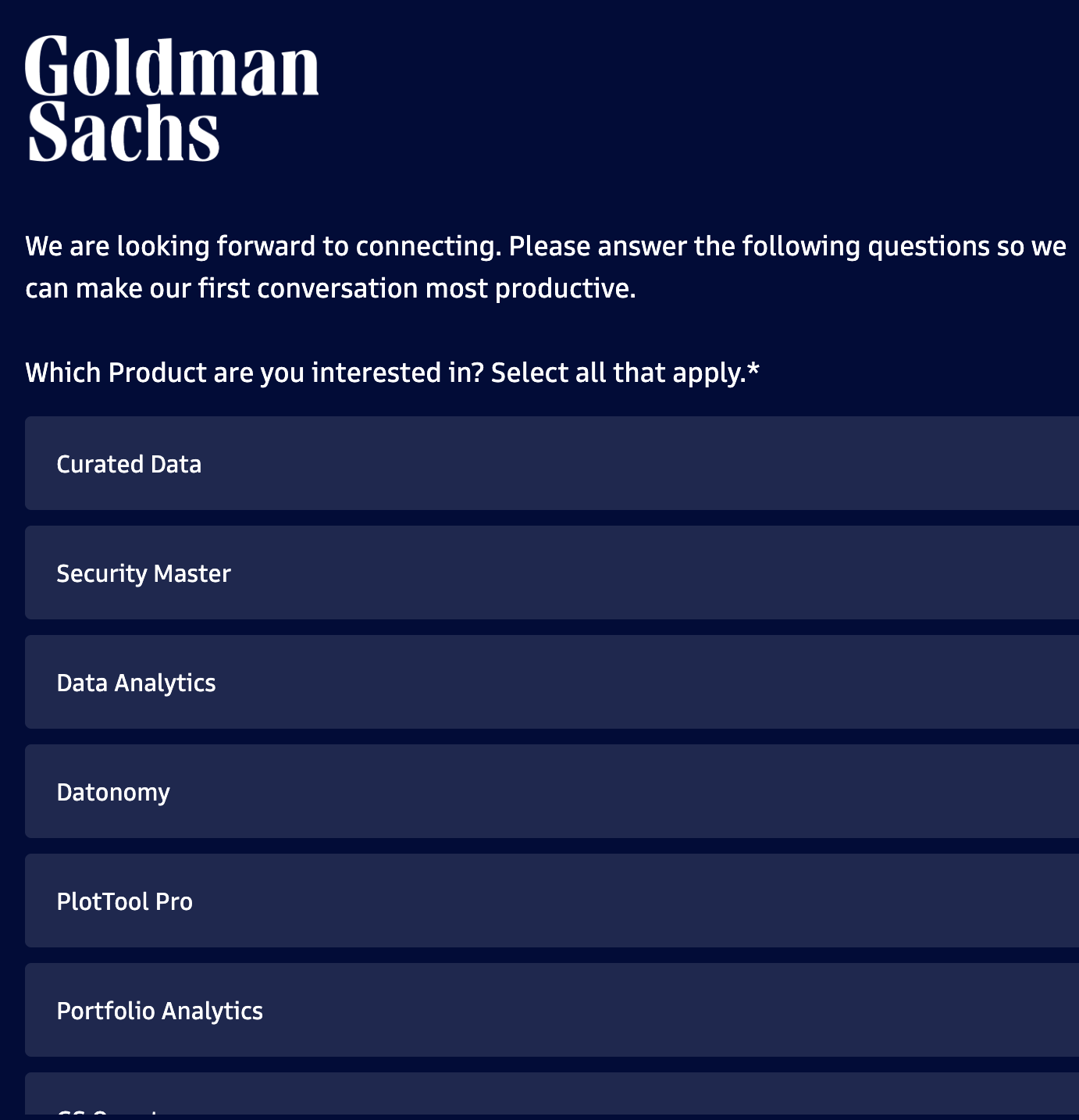
 

Screenshot from user intent collection on the Goldman Sachs Developer Portal for the 2026 Pronovix Developer Portal UX Maturity Report

Goldman Sachs developer portal (screenshot May 2026) – user intent collection (start)


Antipatterns to avoid

  • Treating early-stage discoverability as undesirable. Statements such as “they are not our target users,” “we do not target individuals,” or “we do not start partnerships online” may reflect legitimate business or compliance considerations. However, these assumptions can also conceal untapped demand and prevent potentially valuable partnerships from entering the discovery and evaluation phase at all.
  • Presuming that missing information will be interpreted in alignment with the provider’s commercial intent. In practice, users and AI-mediated systems tend to interpret ambiguity conservatively: inaccessible, fragmented, or unclear information often reduces confidence rather than reinforcing exclusivity or trust.
  • Preventing independent commercial evaluation during discovery. If business stakeholders cannot independently understand pricing models, onboarding expectations, partnership structures, regional availability, or implementation prerequisites, evaluation journeys frequently stall before meaningful engagement begins.
  • Restricting machine-mediated discoverability through gated information architectures. Publicly accessible information layers form the retrieval surface for AI-assisted search, recommendation systems, and large language models. Content hidden behind restrictive login walls or fragmented across inaccessible systems is significantly less likely to become part of the new digital maps of the world.
  • Assuming that technical discoverability alone is sufficient. Even when APIs are technically documented, missing commercial context, solution framing, or partnership guidance weakens both human and AI-mediated evaluation by separating implementation feasibility from business viability.

Frictionless documentation access: trap or gap?

Is the pre-login content leading to success or depression?

Login depression occurs when a portal forces users to create an account before they can properly evaluate a solution's technical viability or business value. 

Banks often gate essential technical and commercial evaluation tools like comprehensive catalogs, API specifications, sandboxes, and pricing behind mandatory registration walls. This can drive away human decision-makers, and completely block AI crawlers from indexing solutions.
The pre-login phase (or pre-authentication journey) functions as the primary discovery and decision-making information base for users before any business commitment is made or any code is written. An optimised pre-login experience serves the evaluation needs of multiple personas: 

  • The commercial persona needs to validate the fit of the business solution on offer to its specific problem to solve, to understand partnership conditions and benefits, and to review the specific integrations costs and compliance.
  • The technical evaluator persona needs to verify the integration's viability from a data and architecture standpoint, to assess the quality of the documentation, and to at least mock test the integration.

Best practices 

Portals that successfully navigate the pre-login phase do so by offering an open, intuitive, and comprehensive discovery experience. They achieve this through: 

  • clear onboarding flows,
  • publicly available overview pages,
  • extensive catalog filtering, and
  • seamlessly connecting business use cases to technical specifications.
  • All without forcing the user to log in.

Examples 

Proper evaluation of technical viability and/or business value is crucial in a frictionless discovery flow. Give unauthenticated users tools to explore the portal’s processes and content as fast as they can through clear expectation management: set clear boundaries, and prevent gaps between what is promised and what is delivered.

Screenshot from intended users on the NBG Developer Portal for the 2026 Pronovix Developer Portal UX Maturity Report

NBG developer portal (screenshot May 2026) – stating who are the intended users for the given API, helping them to quickly discover solutions fit for their needs


Screenshot from an API card on the ABN Amro Developer Portal for the 2026 Pronovix Developer Portal UX Maturity Report

ABN Amro developer portal (screenshot May 2026) – providing clear links on its API cards (business overview and technical documentation, leading to further instructions on what the user will get information about when
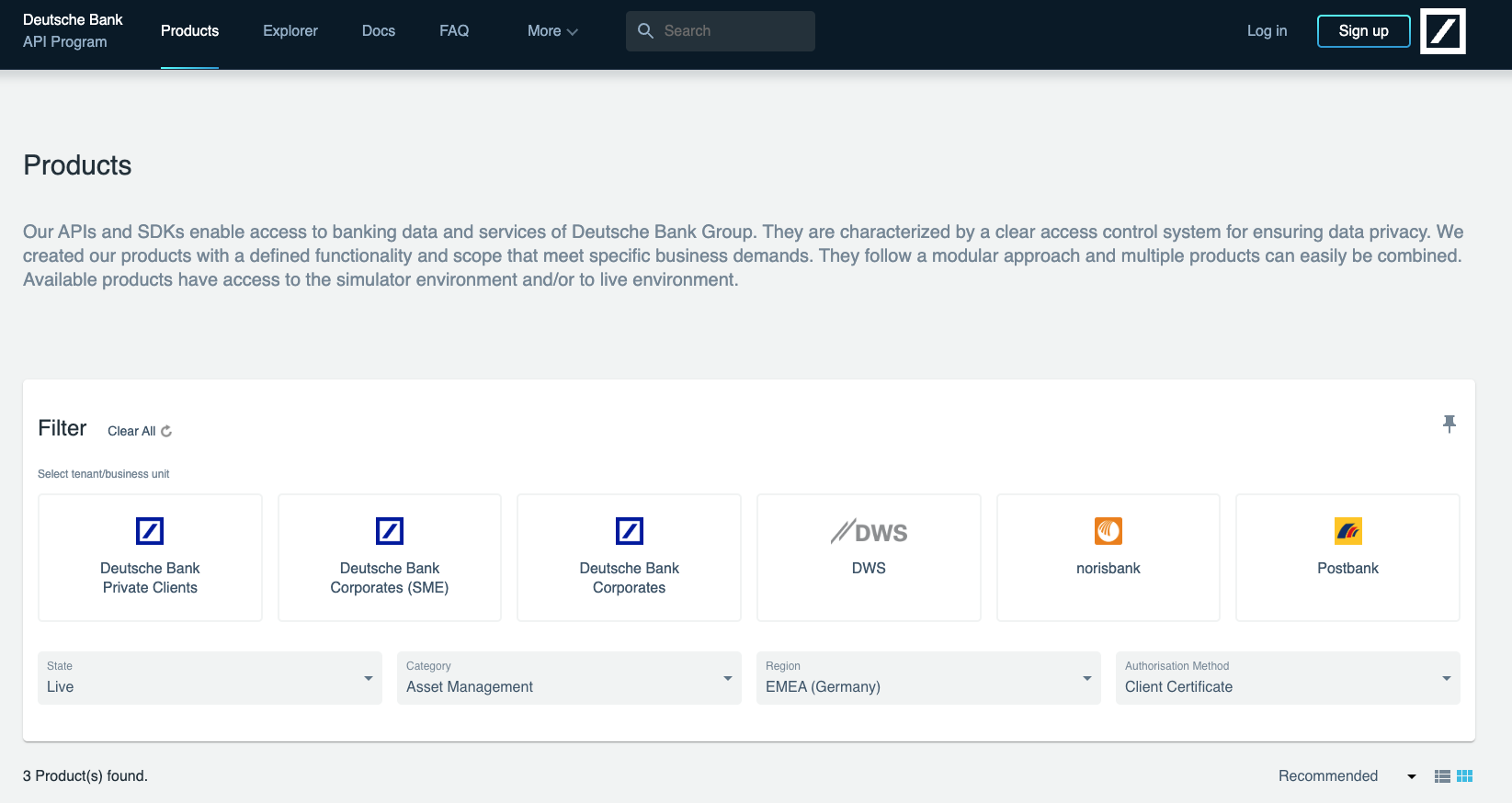
 

Screenshot from product filers on the Deutsche Bank API Program Portal for the 2026 Pronovix Developer Portal UX Maturity Report

Deutsche Bank developer portal (screenshot May 2026) – enabling detailed filtering to easily select an area of interest


Screenshot from detailed filtering on HSBC Developer Portal for 2026 Pronovix Developer Portal  UX Maturity Report

HSBC developer portal (screenshot May 2026) – enabling detailed filtering to easily select an area of interest


Antipatterns to avoid

  • Lost momentum leading to user abandonment.
  • Hiding commercial APIs' documentation behind restrictive login walls that completely block that content from discovery.
  • Missing indicators on “what’s next”: opaque browsing experience, no early descriptions of what products are about, no hints to the following action step

How do banking developer portals treat the hybrid user? 

The hybrid user is a human who relies on AI tools (such as LLMs or copilots) to discover, interpret, and evaluate a developer portal. 

Some traditional banking portals remain gated, technically dense environments designed for human developers. Others have begun to adopt a more commercial framing of their capabilities. However, both approaches often fall short of the hybrid user’s need for immediate, AI-friendly structural clarity.

While this report has focused primarily on the human cognitive friction driving the pre-login journey, it is critical to understand that every human UX failure mentioned previously compounds to form a complete roadblock for AI agents and large language models.

Our complementary AI-visibility report assessed 11 major banks' developer portals along four main evaluation pillars, in April 2026: 

  1. Accessibility and availability
  2. Structure and semantics
  3. Agentic readiness
  4. Authority and provenance 

The report is available through this link »»

Conclusions

Across the assessed portals, differences in pre-login transparency consistently influenced the quality of early discovery and evaluation journeys. Clear technical and commercial information before authentication helps both human evaluators and AI-mediated systems establish context earlier in the discovery journey.

Portals that align their structure more closely with user intent generally enable lower-friction discovery journeys. In practice, this often means organizing capabilities around user problems, practical use cases, and externally understandable language rather than around internal organizational structures or product silos.

A recurring antipattern is fragmentation across domains, business units, and content systems. When business context, onboarding guidance, technical documentation, and support resources are distributed inconsistently, both human users and AI systems face weaker continuity and greater effort during evaluation.

We all see the growing pressure toward hybrid workflows. Discovery, comparison, and early evaluation increasingly begin in AI-assisted environments before direct engagement takes place. In this context, machine readability, semantic consistency, and GEO fundamentals are becoming part of broader portal maturity rather than isolated technical concerns.

Every unnecessary gap in terminology, architecture, navigation, or accessibility increases the cost of discovery. Human users experience this as friction, uncertainty, or missing context. AI-mediated systems experience it as weaker retrieval quality, fragmented signals, and lower recommendation confidence.

Over time, these signals and their absence also shape how an organization’s capabilities are represented and contextualized within AI-assisted discovery environments.

Within the evaluation framework used throughout this assessment, portals with clearer continuity between business capabilities and technical implementation detail generally aligned better with the criteria for high-quality discovery and evaluation experiences. This was especially visible in hybrid workflows where users and AI-assisted systems relied on consistent contextual signals across the journey.

For organizations reassessing their developer portal strategy, this increasingly means moving beyond compliance-oriented API exposure toward portal environments designed for discoverability, contextual clarity, and evaluation readiness. As discovery increasingly happens through external AI-assisted systems, maintaining a clear and authoritative canonical source of information becomes strategically important.

Is your developer portal discoverable, understandable, and actionable 
in AI-assisted workflows?

At Pronovix, we help organizations identify structural weaknesses such as semantic gaps, fragmented architectures, and disconnected discovery journeys. From there, we help align developer portal environments with current best practices for developer experience, machine accessibility, and integration discoverability. 

Book a Discovery Session

References

What do we mean by “developer portal”?

The portals we assessed operate under a variety of names, including developer portal, marketplace, open banking portal, and similar variants shaped by regional markets, partnership models, or developer-focused positioning. Despite these differences, they all serve as integration storefronts: environments where APIs and related digital products connect technical integration capabilities with business value.

What these portals share is a broader process of productization, whether driven by legislation, monetization, ecosystem expansion, or strategic openness. For simplicity, we use the term “developer portal” as an umbrella term throughout this report. However, our focus extends beyond developers, to all user personas (human or AI-mediated) who access these environments directly or indirectly for discovery, evaluation, and integration research purposes.
 

How did Pronovix conduct these evaluations?

During the UX maturity and AI visibility assessments, conducted on 19 “best-in-class” portals in the financial industry, we worked as followed:

  • The UX maturity audit’s foundation is based on the six stages of the business user and developer journey (discovery - decision-making - onboarding - go live - maintenance - community) with 130+ scorable practices set by Pronovix. In this report, we mainly focus on the stages of discovery and decision making, but may touch upon the other areas of the journey if relevant.
  • For the results of the AI-visibility assessments, visit the signup page to get access.  
     

Evaluated developer portals 

ABN AMRO Developer Portal, https://developer.abnamro.com 
BBVA API Market, https://www.bbvaapimarket.com/en/ 
BNY Developer Marketplace, https://developer.bny.com
Capital One DevExchange, https://developer.capitalone.com
Citi Developer Landing Page, https://developer.citi.com
Commerzbank Developer Portal, https://developer.commerzbank.com 
Danske Bank API Marketplace, https://developers.danskebank.com 
Deutsche Bank API Program, https://developer.db.com 
DNB Developer, https://developer.dnb.no 
Erste Developer Portal, https://developers.erstegroup.com
Goldman Sachs Developer, https://developer.gs.com 
HSBC Developer Portal, https://develop.hsbc.com 
J.P. Morgan Developer, https://developer.jpmorgan.com
NBG Developers Portal, https://developer.nbg.gr 
Nordea API Market, https://developer.nordeaopenbanking.com 
Payments Developer Portal, https://developer.payments.jpmorgan.com 
Raiffeisen Developer Portal, https://developer.raiffeisen.at
Standard Chartered open banking, https://openbanking.sc.com
U.S. Bank Developer Portal, https://developer.usbank.com

We primarily assessed the main portal surfaces while mapping connected domains and supporting properties such as status, support, or product-specific sites. This made it possible to evaluate how consistently information, authority, and context are distributed across the broader portal ecosystem.

Rather than exhaustively reviewing every available product or feature, we used representative sampling to identify recurring patterns, strengths, anomalies, and hidden gaps across the observed developer portals.
 

Disclaimer

Pronovix has spent over a decade focusing on designing, building, supporting, and advising on developer portals, including auditing their user experience, architecture and content. We offer professional services in user experience design and content for our clients. 

For this 2026 report on banking and financial services developer portals we were not paid by any of the organizations reviewed, and our evaluations were not influenced in their favor.

Before publishing, we contacted the assessed organizations. We are intentionally not giving company-specific examples for antipatterns. When requested, we shared our assessment methods and findings. While we considered their feedback, errors may still occur; please contact us if any corrections are needed.

Newsletter

Articles on devportals, DX and API docs, event recaps, webinars, and more. Sign up to be up to date with the latest trends and best practices.


Subscribe